The deeper the craving, the deeper the aversion.
The deeper the aversion, the deeper the affliction.
I recently spent ten days at Dhamma Salila, from September 9th to September 20th, sitting a Vipassana meditation course.
This was my second course. I had attended one in February 2024, and this time I wanted to hit reset and return to the practice. The second course also helped me close some of the gaps in my learning and understanding.
The practice is built around three parts:
- Sīla — moral conduct and discipline
- Samādhi — concentration and mastery of the mind
- Paññā — wisdom through direct experience
Over the ten days, I began to see the practice less as a straight path and more as a loop. Each step leads into the next, and the cycle repeats with a little more awareness.
The practice as a loop
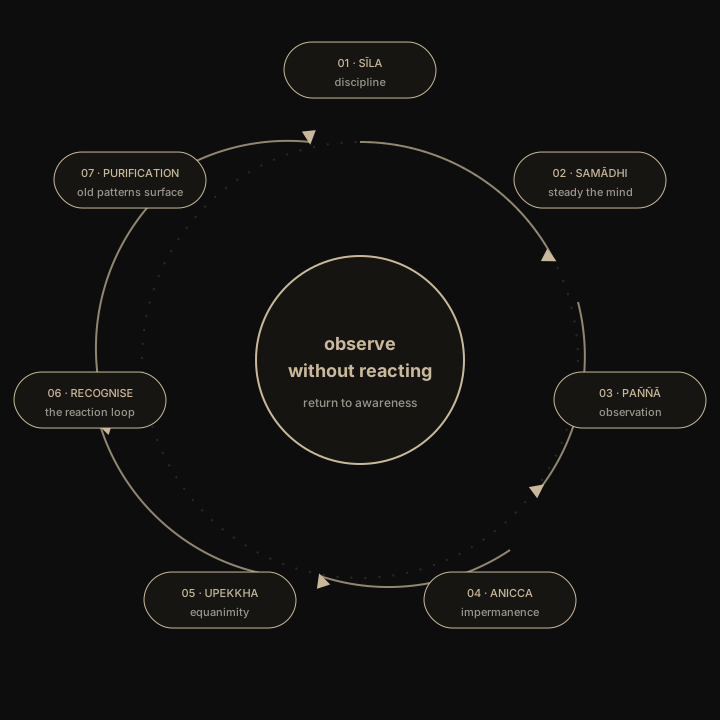
1. Sīla — creating the conditions
Noble silence and discipline created the space to observe what was happening internally.
2. Samādhi — steadying the mind
The initial practice was to observe the natural breath without trying to change it. The work was simply to keep returning to it and gradually make the mind steadier and sharper.
3. Observation (Paññā) — turning inward
The practice then moved towards observing sensations throughout the body. Some were obvious and intense; others were subtle and easy to miss.
4. Impermanence (Anicca) — seeing things arise and pass
The sensations kept changing. Whatever appeared eventually passed away. Impermanence stopped being only an idea and became something to observe directly.
5. Equanimity (Upekkha) — neither craving nor resisting
The practice was to observe sensations without immediately reacting to them. Pleasant sensations invited wanting, while unpleasant ones invited resistance. The work was to remain balanced through both.
6. Recognition — seeing the reaction loop
A sensation appears, the mind labels it as pleasant or unpleasant, and craving or aversion follows. Repeated observation helped me see this loop more clearly.
7. Purification — allowing old patterns to surface
Older patterns and reactions seemed to surface. The practice was not to suppress them or act on them, but to observe them with equanimity. In that observation, some of them seemed to lose their hold.
A week after returning, the practice has already begun to leave small, traceable marks: less reactivity and impulsiveness towards events and things, more ease with myself, and a greater sense of presence.
I don’t think ten days—or even two courses—are enough to claim any permanent transformation. The practice still requires continuity. But this course helped me return to something I had allowed to drift, and it helped me understand parts of the practice that had previously felt incomplete.
Perhaps that is what I needed from this course: not a dramatic conclusion, but a reset, a clearer understanding, and a way back to the practice.
When the mind remains aware and equanimous in every situation, without becoming disturbed, our decisions naturally become more balanced.